by Ronda Birtha
I’m going to guess that for many people reading this post, killing a rooster is not a big deal. So I’m just going to ask all of you to whom this is old hat … please indulge this city girl.
I’ve known Bill and Janet Silver from Murphy, NC for about 9 years, and they have been to me among the most hospitable, kind-hearted people I have known. I don’t know when I started calling them Papa and Mama but I fell into it so casually because they treat me like one of their own children. This past Monday, I got to experience what each of their children had been accustomed to seeing, doing and helping out with all their lives until they each left home – preparing a rooster for dinner.
She warned me that the killing to canning event would be an all day affair, and that I probably wouldn’t want to eat chicken for some time after. Other friends of mine said they wanted to be there, not for the killing, but to see my face when the ax fell. Although a Jersey girl, my parents are from the south, my father grew up on his father’s farm, and I witnessed my uncle kill a hog one winter. It took a few months for me to become a carnivore again but I survived it.
12:00pm “Outside the pen … he’s no longer a chicken … he’s a carcass”

Photo credit: Ronda Birtha
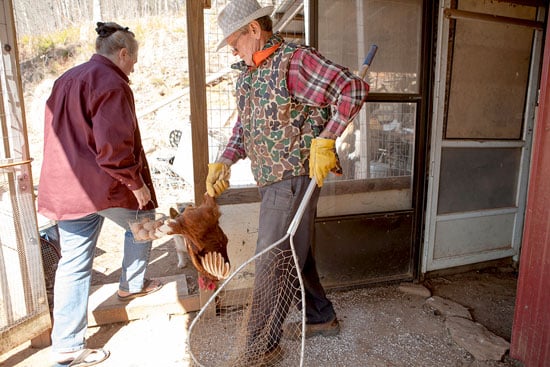
Bill came home for lunch to do the kill for me. We walked to the pens where he has about 30 or so chickens and a handful of chicks split between two immaculately kept hen houses. He scattered scratch for them while Janet gathered the eggs in the roosts. I spent two weeks at the end of last summer taking care of his chickens and their daughter-in-law’s horses, so this routine wasn’t new to me.
To help me wrap my head around what was going to happen, though, Janet told me that while the unsuspecting chicken is in the pen, he’s a chicken. When he’s out of the pen and on his way to the chopping block, he’s a carcass. That’s it. Her father helped her with that distinction as a child, and she maintained it with her children when they were growing up. In fact, she said they named the animals “hamburger” and “steak” and “chicken” so that they could get used to the fact that, while they may get attached to them as pets, they are all eventually going to become dinner.
From the time Bill caught the rooster and during the walk to the chopping block the rooster didn’t make a sound, squawk, cluck, flutter its feathers, nothing. I asked Bill what was up with that.

Photo credit: Ronda Birtha
“Oh, he knows he’s caught,” Bill answered as he cradled the rooster in the crook of his arm. “Poor guy.”
“Don’t believe him,” Janet called out to me.
Bill began to smile. He admitted later that a kill was still tough for him if he got attached, but if the bird was a nuisance, he didn’t think twice about it. Bill and Janet are both sensitive people, but that sensitivity is tempered by practicality – one of their many admirable traits that makes them such well-balanced people. Once when Bill told me about a hawk getting one of his baby chicks I commented how horrible that was. He answered simply, “Well, they got to eat, too.” True.
Bill laid the rooster on the block of wood. No fight, no fanfare. He asked me if I was ready and I snapped the series of pictures just before, during, and after he dropped the ax. I wasn’t traumatized by the kill, or by the headless corpse running laps around the yard, and not even when it leapt about three feet in the air and finally expired. But it was the picture just before of Bill holding the rooster that affected me the most. As if the rooster was resigned to what was about to happen.

Photo credit: Ronda Birtha
12:44 Pluck pluck pluck
Inside the house, Janet boils water for the kettle that the carcass will be dumped into in order to make the feather plucking easier.
“It has to be about 140˚.” She pours the boiling water into a kettle and then adds another pot of warm tap water. Before checking it with a thermometer she stirs the water to make sure she gets an accurate reading of the mixture. She’s always measured it by feel until her son-in-law, who worked on a farm, gave her the thermometer. When it feels right to her, she dips it in the water, pulls it out and waits for the needle to settle.
“One-forty-one. Not bad.”

Photo credit: Ronda Birtha
As Janet plucks the feathers from the bird, she tells me why this bird is not going to taste anything like the birds I’m used to bringing home from the supermarket. The meat will be tougher because the home-grown birds roam about, run free, build up some muscle. The commercially raised birds eat feed loaded with chemicals and live out their lives in confined spaces.
“They [commercially raised birds] are bred for tenderness, but a store bought chicken doesn’t even taste like chicken if you’re used to home grown chicken.”

Photo credit: Ronda Birtha
1:30 Disjointing, not butchering
Janet’s father told her that butchers are called such because they, “just cut [the animals] up, they whack through the bones. But if you disjoint them you don’t have to break the bones.”
I felt like a med-student watching a surgeon during a training session. And like any good instructor, Janet wanted me to participate. I agreed to stick my hand in the carcass and feeling its gizzard and liver and other organs that my fingers could access.

Photo credit: Ronda Birtha
She started with the wing and explained every step of where she started making incisions or cutting, along with how and why. At the end of the process there was a pile of neat legs, thighs and breasts, and other “serving pieces” ready for the pot.
3:30 The Broth
“When you look at it and it looks lemony, like lemonade, that’s a sign that it’s a good soup stock. It’s not real watery and clear. And when you put it in the refrigerator it will gel up like Jell-O. And that, too, is a sign of a good soup stock. It’ll have a good flavor to it.”
Along with the usual vegetables Janet includes the celery leaves because, “they too have really good flavor,” and one parsnip. If the soup was to be eaten right away she would use a potato instead. But since the soup is getting canned, a parsnip won’t turn to mush over time as a potato would.

Photo credit: Ronda Birtha
5:00 to 8:00 pm The Soup
It’s a full three hours from time she fills the canning kettle to the time she pulls the jars out and settles them on the counter. While on the counter, the jars are still bubbling. She tells me that the bubbling is a good sign that they will all seal. Within moments, one lid puckers slightly in the center.
“If they don’t seal you either have to eat it right away or reprocess it because it won’t keep.”
She tells me that they need to sit overnight before they are ready to go so I promise to return the next day for my jar.
But as an ordinary gesture of her kindness, the next day, she gives me the entire batch.

Thanks, Mama and Papa Silver.
________________________________________________________________
 Ronda Birtha is a freelance writer, photographer, and videographer residing in far, far western North Carolina. She has been an instructor for the Community Folklife Documentation Institute/NC Folklife Institute; and as Project Consultant for the Mountain Work: A Social Commentary documentary, partially funded by a grant from the NC Humanities Council. Samples of her photography and videography can be seen at www.rondabirtha.com. In the five or ten minutes that she has for herself in the course of a day, she continues to work on her first novel – Solace.