by Deborah Miller
These are the things that keep me up at night. I’m an unashamed “wonderer.” My friends all laugh at me when I’d ask “those” questions. You know, “why are some raindrops big and some little?” and “who ever figured out how to eat an artichoke in the first place?” Yes, they’d even air quote me when they saw one coming. I’m content to stay curious, now and forever more. Somebody warn me if I ever stop.
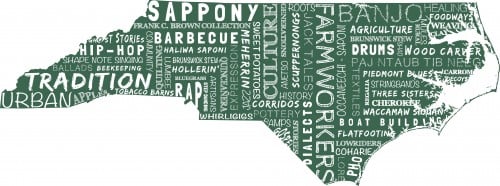
Officially, how does a symbol get to be “official” anyway? The best answer is that it’s not always clear. For instance, North Carolina has 42 official state emblems, though those emblems don’t necessarily include places or events that are considered official. Typically they are iconic, with a connection to our specific heritage, have contributed to the success of our economy, or are unique to North Carolina alone. You might be surprised to learn that while laws have been enacted to name a state art medium (clay, 2013), two of our most important designations “the Tar Heel State” and “The Old North State” are actually rogue, having never been “officially” passed into law by our General Assembly. Now I’m going to wonder if that means someone could clog or shag (our official folk and popular dance respectively*) right on in here and steal them if they’d a mind to.
I was one of those laughing when the Virginia Opposum was named the official Marsupial of North Carolina. (General Assembly Session Laws, 2013, c. 189.) I mean, shouldn’t our own marsupial at least have the name of our state instead of the one just to the north of us? It might be because of all the national publicity we received over that controversial New Year’s Eve Possum Drop in Brasstown, NC.
Also curious is that there is an official state fish AND an official state trout. I’ve always thought a fish was a fish was a fish, but I’ve been wrong before.
Here’s our challenge to you. Pick one of the state symbols from North Carolina’s Official State Symbols That Taste Good, Part 1 or Part 2 and go in-depth with it. We’ve barely scratched the surface.
Final question. Is there an official state recipe, and if not, why not, and what should it be? Send us your favorite recipes that include these “official” state symbols!
*General Assembly Session Laws, 2005, c. 218.
……………………………………………………………………………………………………………………
North Carolina State Insect, Honey Bee*
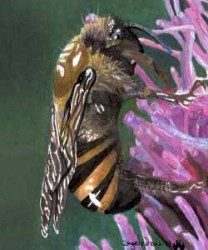
Did you know that the honey bee annually produces more than $2,000,000 million worth of honey in the state? That’s a lot of sweetness! Turns out, though, that the honey bee is a major contributor to the pollination of North Carolina crops and that’s where the value lies.
Coincidentally, the Honey Bee is the featured symbol of the month (March, 2015) by NCPedia.
* General Assembly Session Laws, 1973, c.55.
………………………………………………………………………………………………..
North Carolina State Freshwater Trout, Southern Appalachian Brook Trout*
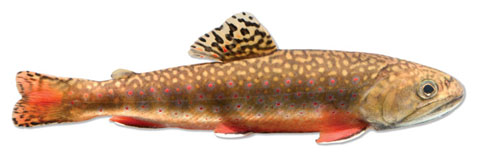
The Southern Appalachian brook trout is commonly found in the state’s mountain streams. North Carolina is home to more self-sustaining populations of the Southern Appalachian brook trout than any other state. Sometimes known as “speckle” trout because of its speckled appearance, the Southern Appalachian brook trout is a favorite of sport fisherman in the cold mountain streams of North Carolina, Tennessee, Arkansas, Georgia, South Carolina, and Kentucky.
*General Assembly Session Laws, 2005, c. 387.
………………………………………………………………………………………………..
North Carolina State Salt Water Fish, Channel Bass (Red Drum)*

Channel bass usually occur in great supply along the Tar Heel coastal waters and have been found to weigh up to 75 pounds, although most large ones average between 30 and 40 pounds.
*General Assembly Session Laws, 1971, c. 274; G.S. 145-6.
……………………………………………………………………………………………….
North Carolina State Fruit, Scuppernong Grape*
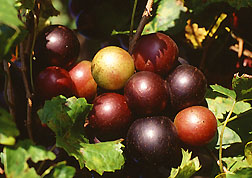
North Carolina has the distinction of cultivating the first grapes in the United States. A variety of muscadine grape, the Scuppernong was named for the Scuppernong River, which runs from Washington County to the Albemarle Sound. The “Mother” of this vine is 400 plus years old with a trunk more than two feet thick.
- Medoc Vineyard in the town of Brinkleyville in Halifax County was the first commercial winery established in North Carolina and led the country’s wine production in 1835. – VisitNCwine.com
Before prohibition, North Carolina was the leading wine producer in the United States. In 1999, the Golden Leaf Foundation began offering incentives to farmers to encourage transition from the dwindling tobacco business and move into growing grapes. Today it is home to more than 100 wineries.
You can still stomp grapes at Duplin Winery in Rose Hill, NC during their Grape Stomp Festival in the fall.
*General Assembly Session laws, 2001, c. 488.
……………………………………………………………………………………………….
North Carolina State Historical Boat, Shad Boat*
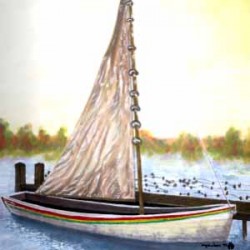
The Shad Boat
While not exactly a food, it is a significant source of food, so it felt important to include the shad boat.
Developed on Roanoke Island and known for its unique crafting and maneuverability, the name is derived from that of the fish it was used to catch – the shad.
Traditional small sailing craft were generally ill-suited to the waterways and weather conditions along the coast. The shallow draft of the Shad Boat plus its speed and easy handling made the boat ideal for the upper sounds where the water was shallow and the weather changed rapidly. The boats were built using native trees such as cypress, juniper, and white cedar, and varied in length between twenty-two and thirty-three feet. Construction was so expensive that the production of the Shad Boat ended in the 1930s, although they were widely used into the 1950s. The boats were so well constructed that some, nearly 100 years old, are still seen around Manteo and Hatteras.
*General Assembly Session Laws, 1987, c. 366.
Stay tuned for Part III, North Carolina’s Official State Food Festivals coming soon.
………………………………………………………….
RESOURCES
NCpedia.org’s State Symbols and Official Adoptions
The History of Wine in North Carolina
Special thanks to the North Carolina Encyclopedia and the North Carolina Manual for detailed descriptions and symbols.
………………………………………………………….
 Deborah Miller, Program Administrator at the North Carolina Folklife Institute, is a native Tar Heel and lifelong foodie with a deep passion for music.