Here in North Carolina we’ve eaten up the winter collard greens, and are eagerly anticipating the early spring crop. Thinking about collards put us in mind of a tradition we learned about some years back, Collard-Stealing Night. Though it may have been practiced in various parts of North Carolina, it seems to have been most especially a Pender County “thing.” (The following text is excerpted from the NC Folk publication “Folklife and Traditional Arts of Pender County, North Carolina,” by Sarah Bryan and Michael Taylor.)
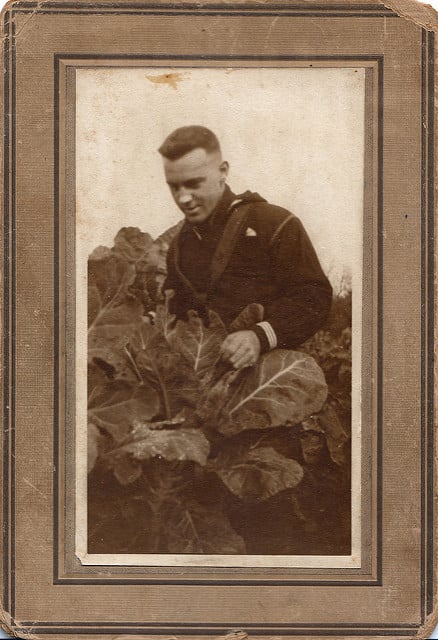
. . . Another cold-weather food tradition, more recreational than practical, was collard stealing. Reported in various parts of Eastern North Carolina, the tradition was apparently strong in Burgaw during the first half of the twentieth century. While collard stealing pranks might be perpetrated anytime in the winter, it seems that in Burgaw it was done primarily in observation of Old Christmas, in early January, on what was known as Collard-Stealing Night.
On Collard-Stealing Night, Burgaw residents would sneak into each other’s collard patches after dark, and cut down a few plants. They would then tiptoe onto neighbors’ porches, where they would pile or strew the leaves, before ringing the doorbell or knocking on the door, and fleeing. In a 1985 article about the tradition in the Raleigh News & Observer, Burgaw native D. Vann Harrell, Jr., described the ideal collards for the job. “You want big ones,”he said. “Ones the size of foot tubs, ones that have a lot of manure on ‘em. The stinkier the better.”
Collard-stealing was mentioned in an article by Edward H. Davis and John T. Morgan that appeared in the journal Southeastern Geographer in 1995, described as an Eastern North Carolina tradition.
“Collard stealing was engaged in by groups of teenagers who would spend hours on a cold December night walking the dirt roads and trails of their rural communities to play tricks on people thought to be wealthy or eccentric. Participants in a few areas participated in collard stealing in early January as a part of the celebration of Old Christmas. In this folk activity, a few mature collard plants would be pulled from a roadside garden, then taken to a nearby residence and dropped on the front steps. The celebrating youths would then knock on the door of the unsuspecting recipients of the collards, yell loudly and run away. The offended resident would answer the door to discover their gift of collards. During the hard times of the Great Depression, the practice of collard stealing was sometimes feigned by teens hwo would bring stolen collards to their own homes and leave them on their steps or porches. Their unsuspecting parents would discover the collards the next morning, thinking they were left by mischievous neighbor kids. Then, of course, they would cook and eat the needed food.”
The author of the News & Observer article speculates that Collard Stealing Night may take place on Old Christmas in Burgaw, rather than simply anytime in cold weather, as in other parts of the region, because of the proximity of St. Helena, where Old Christmas is observed. (Home to several waves of European immigrants, St. Helena has its own interesting culinary history, the subject of a future post.)
In the same article, the author says that Collard Stealing Night was looked forward to by young people with the same kind of fervor as Halloween is today. One wonders also if there might be connections to the African diaspora tradition of Jonkunnu, which was celebrated in Eastern North Carolina, and prominently features tricksters and tricks.
“High spirits often led to neighborly high jinks on the appointed night: ‘We might take the mule out of the stable and put it over at another fella’s place,’ said Harrel, 65, of Burgaw. ‘Sometimes we’d check behind the tobacco barn to see if they had a wine barrel.’
“If the youths knew a man who hated goats, they might find one and put it in his stall, he said.
“Even though the young people played mischievous pranks, ‘there was no harm intended,’ he said.”