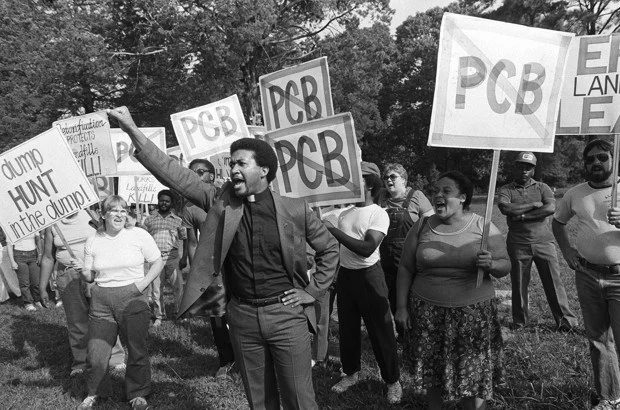
Warren County, North Carolina is considered by many to be the birthplace of the environmental justice movement. In 1982, after four years of unsuccessful litigation, Warren County citizens and protesters used principles of non-violent protest to oppose the dumping of toxin-laced soil into a Warren County landfill. 55 citizens were jailed.
According to Wikipedia:
The purpose of the Warren County PCB landfill, as the public knew it, was to bury 60,000 tons of PCB-contaminated soil that had been contaminated with toxic PCBs between June and August, 1978, by Robert J. Burns, a business associate with Robert “Buck” Ward of the Ward PCB Transformer Company of Raleigh, North Carolina. Burns and his sons deliberately dripped 31,000 gallons of PCB-contaminated oil along some 240 miles of highway shoulders in 14 counties.”
According to census data, of nearly 18,000 Warren County citizens, almost 70% were non-white, with 20% living below the poverty level.
The Washington Post described Warren County’s PCB protest movement as “the marriage of environmentalism with civil rights,” and in its 1994 Environmental Equity Draft, the EPA described the PCB protest movement as “the watershed event that led to the environmental equity movement of the 1980’s.”
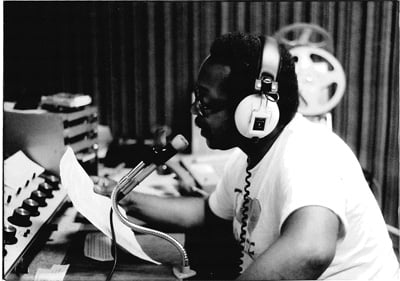
In this episode Rev. Bill Kearney recounts the lasting impact of these actions.
 Credits
Photo courtesy messynessychic.com
Produced by Joseph O’Connell, with Evan Hatch and Joy Salyers.
Underwritten by Resourceful Communities and the North Carolina Folklife Institute.
Interview with Rev. Bill Kearney by Joe O’Connell (NCFI, 2016)
News broadcast audio accessed on YouTube: https://www.youtube.com/watch?v=1iCxh0BYjgI
“Dig a Little Deeper” by the Royal Jubilee Singers, recorded by Mike Taylor (NCFI, 2009)
Additional music by Joe O’Connell
External Links
- Environmental Injustice in North Carolina: https://sites.duke.edu/docst110s_01_s2011_sb211/what-is-environmental-justice/history/
- Carolinians Angry Over PCB Landfill: http://www.nytimes.com/1982/08/11/us/carolinians-angry-over-pcb-landfill.html
- North Carolina PCB Archives: www.pcbarchives.com