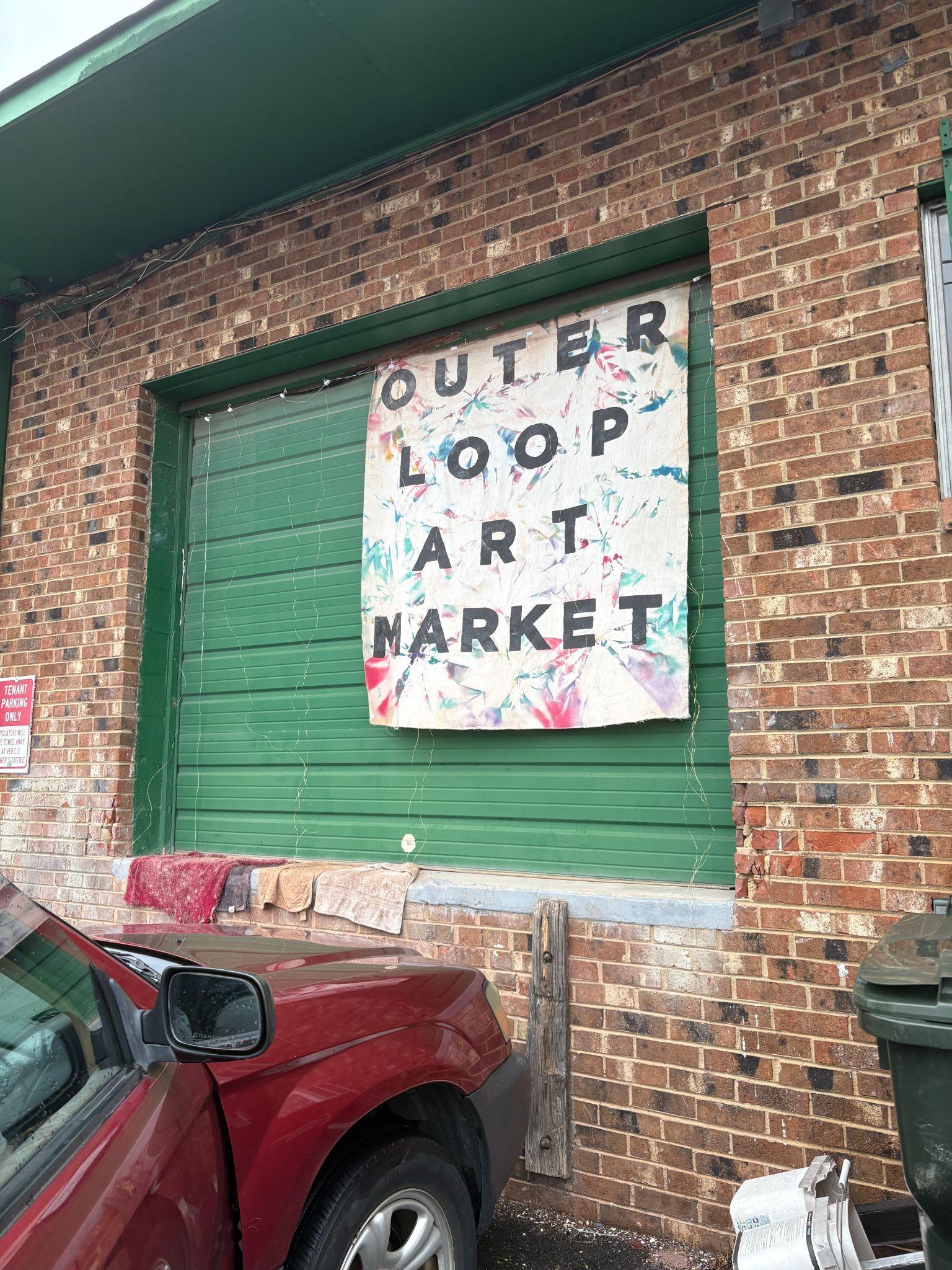
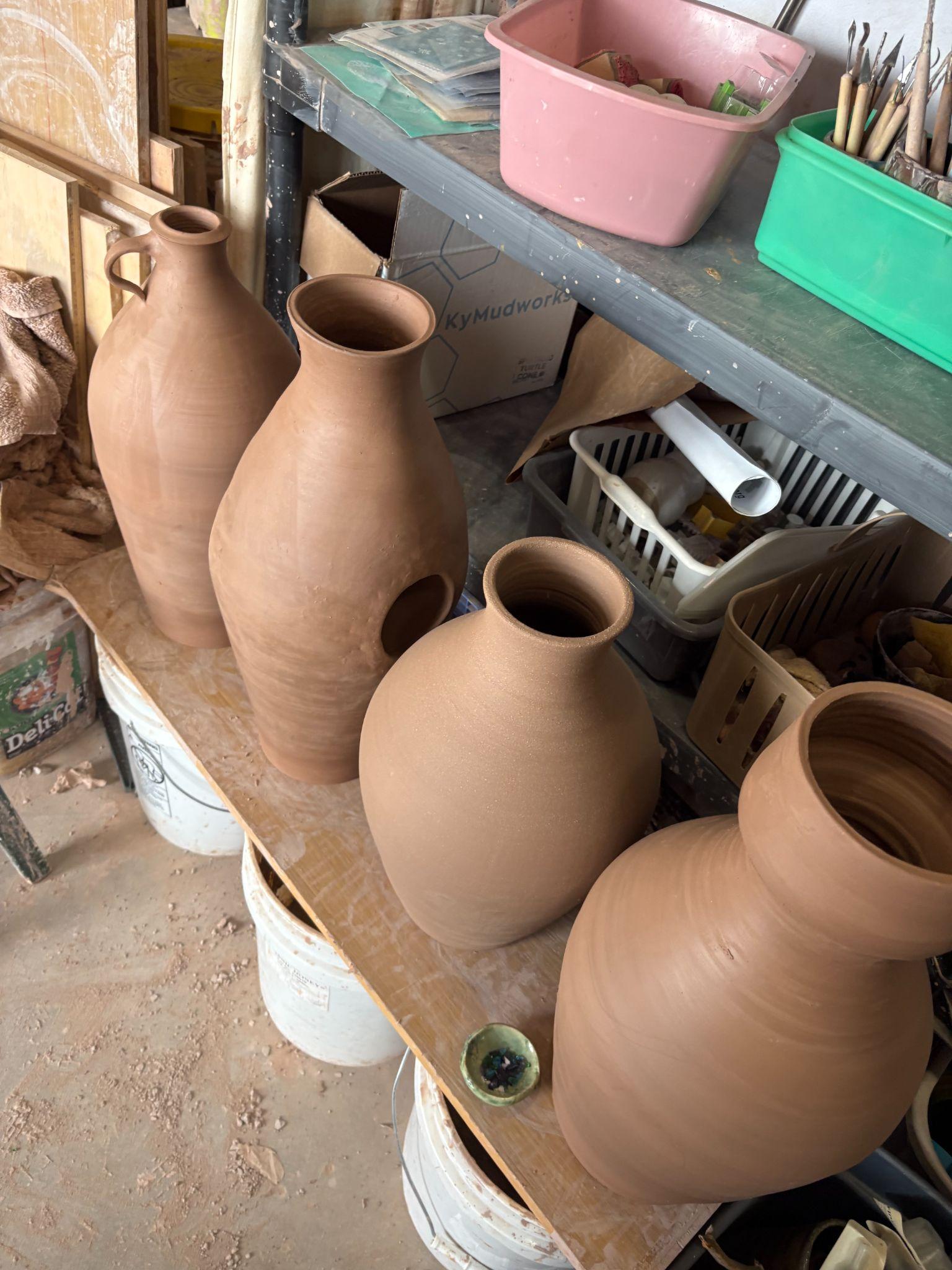
When potter Julie Hinson is in her studio, her bright green garage door is pulled open and string lights dangle from the ceiling, their ends just barely brushing the top of the clay dust-covered floor. Her studio is part of Outer Loop Arts, a maker and retail space that she co-founded in Durham’s Golden Belt Historic District in November of 2020.
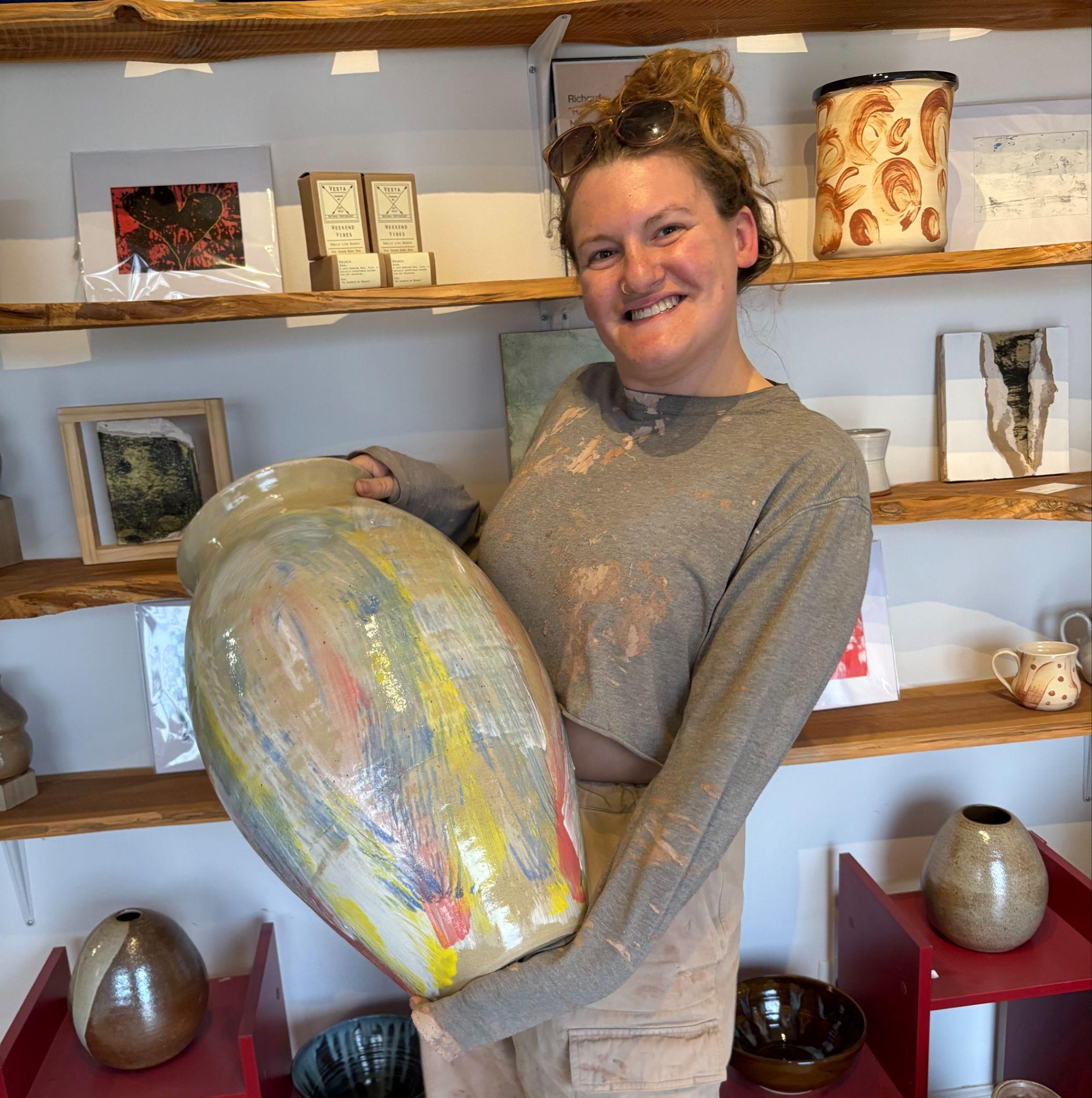
Julie is one of four artists who currently work in Outer Loop Arts. She’s the only clay artist, and the positioning of her studio—directly by the garage door—allows for her to work with the sunlight and to easily sweep the space when it gets messy. Both her wedging table and wheel look out towards the door; when it’s open, you can see and hear the constant bustle of downtown Durham—delivery people with packages say hello as they walk by, cars drive down the streets, people walk their dogs and look in curiously, and the occasional train rumbles by, its sides painted with graffiti.
However, despite currently being a full-time potter and pottery teacher, Julie didn’t always consider herself to be an artist—at least not before she lived in Seagrove.
Julie got her start in pottery while living in Seagrove, North Carolina—a small town in the Piedmont largely considered to be the Handmade Pottery Capital of the U. S. and holder of the longest nonnative pottery tradition. Originally from Durham, Julie moved to Seagrove after living in New York City where she worked a high intensity job as a butcher for several years.
“I find so many parallels between working in the butcher shop and working in clay,” Julie says. “Meat and clay are shockingly similar.”
There are also similarities between how butchering and wood firing are male-dominated fields. “I think that experience definitely informed a lot of how I think about feminism and making and work now,” she says.
While visiting Seagrove after leaving New York in 2017, Julie and her mom had lunch with Sid Luck, a fifth generation North Carolina potter who offered Julie an apprenticeship. In exchange for helping around the studio, Sid provided Julie with a camper on his property and a pottery education.
“I figured I would be there for three months or so, and it ended up being closer to three and a half years,” Julie says. “I just really fell in love with pottery when I was out there.”
While working under Sid, who runs a full-scale, old-school pottery business, Julie would fix the kiln, dig clay to make slips, cut down trees, use the sawmill to cut slabs and logs, and make pots. Each morning, she would wake up, go for a run, and then start a fire in the wood stove to heat up the water and keep the shop warm. Then, she’d figure out what she was making for the day—mugs, bowls, pots, or even just glazing. With a production potter, there’s a lot of making.
Back then, the town of Seagrove was much smaller than it is now. When Julie lived there in 2017, the closest place you could get an espresso at was in Asheboro, twenty-five minutes away. Now, there’s a bar, coffee shop, and multiple restaurants. Watching the resurgence of social life in downtown Seagrove has been a really cool experience, Julie says.
It was while living in Seagrove, during the first Trump administration and Brett Kavanaugh’s Supreme Court controversy, when Julie first started making pieces depicting the nude female figure.
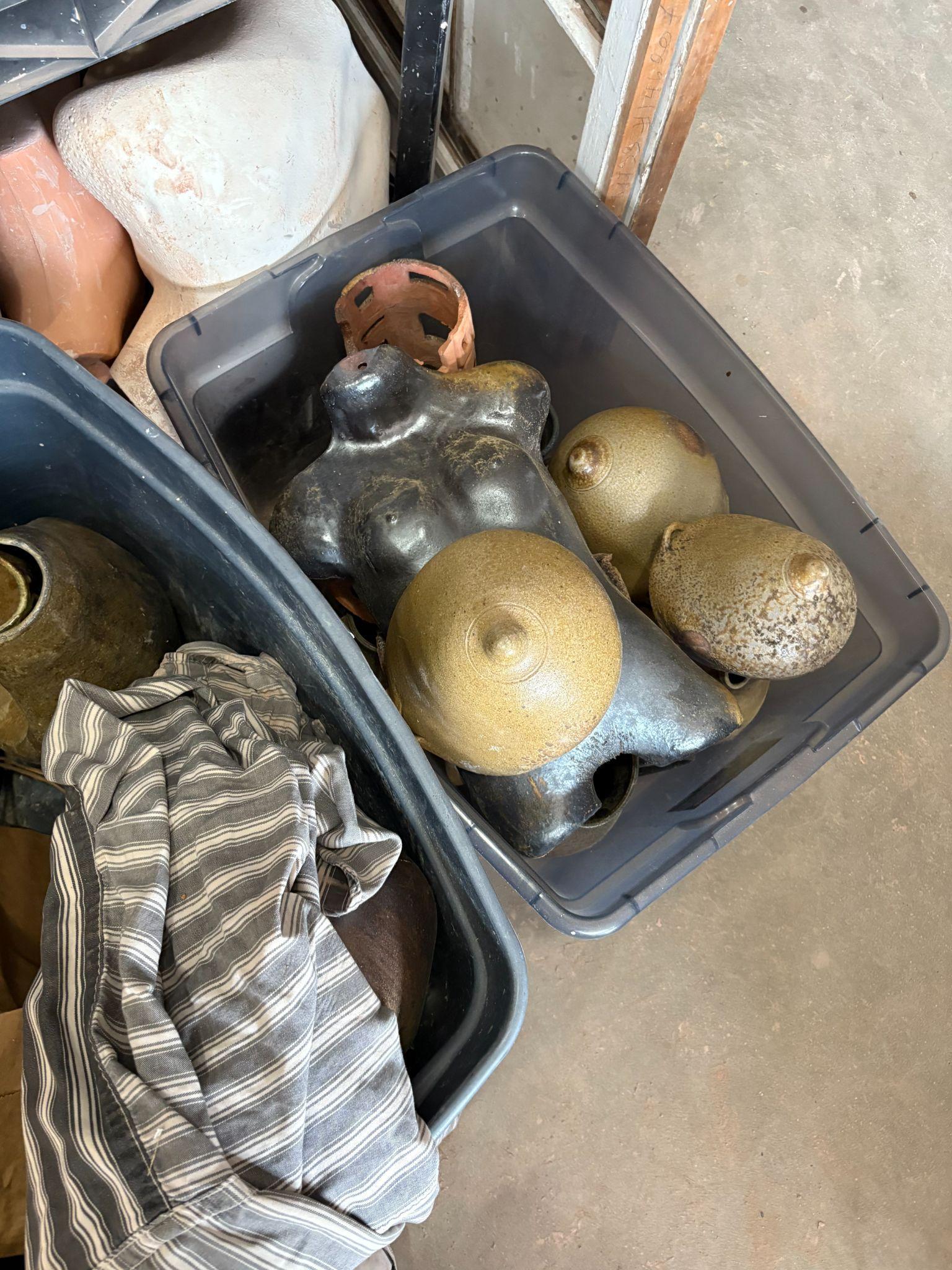
The female body plays a large role in Julie’s pottery. Often when making breasts, they are standalone—individual domes thrown on the wheel and shaped with tapping. Other times, Julie makes larger female body forms by throwing a curve and pressing creases in it to signify breasts, hips, and butts. If adding them onto another piece, she’ll form a little breast then score it on with a bit of slip. These pieces start conversations about what is and is not okay, what people consider to be normal versus what they consider to be transgressive.
In these pieces, Julie pushes back against the female body always being an object and never the subject.
“I really try to make pots that people look at and are like, ‘Oh, that’s what my body looks like’” Julie says. For her, the most important part is to make pots that show an experience of what it is like to be in a body “as a woman, as a human, because it’s a weird, gross, sometimes uncomfortable thing, and that is beautiful.”
Julie incorporates a lot of the feminine into her work—whether the general shape or the content. Sometimes she will stamp parts of essays or poems onto pots. Recently, she made a large basket pot that has Zoe Leonard’s “I want a president” stamped all along the outside.
“And that is just one of my favorite pots and one of my favorite poems,” Julie says. “I really do try to take stuff from the everyday and incorporate it into my work.”
Like many art forms, Julie has noticed that pottery often falls victim to the idea that if a woman does it, it’s a hobby or novelty. But if a man does it, it’s art. Even now, Julie—along with other women makers—have to defend their work, especially if they make big pots. The big pot is a form many people still don’t believe women can do.
At shows or gallery openings where Julie brings big pots, she will often receive comments from people who are shocked a woman could make something that big.
“I lifted this big, heavy thing myself and created it all on my own,” she says. It is because of this, and because most of the well-known potters in the country are men, that Julie believes it’s important to recognize women makers for what they are—artists.
When starting a pot—or any other ceramic piece—Julie doesn’t sketch it out.
I really don’t think that I ever really know exactly what I’m gonna do when I sit down at the wheel,” she says. Instead, she lets the clay tell her what she wants to do.
Some potters sketch their pots out and try to make them look exactly like the sketch, sometimes even working inch by inch. For Julie, not using a sketch means that she’s embracing the folk pottery aspect of making. This means she gets to experiment a lot with her work.
“Often I will start with an idea,” she says. “A lot of what I do is self-taught. A lot of what I do is just kind of experimenting or seeing a pot and trying to make something like it. Like it’s fun, but it’s always a lot of work.”
Julie’s studio reflects this idea of experimentation and fun. When the wind blows through the open door, it rustles the decor hanging from the walls: clay art dangles from fishing wire and bumps into other pieces, the paper to-do list flutters then settles, cookie cutters and measuring tape and empty spray bottles rattle and chime as they collide. In the background, a mix of classical music and jazz softly intertwines with the twinkling of the cookie cutters and the honking of cars.
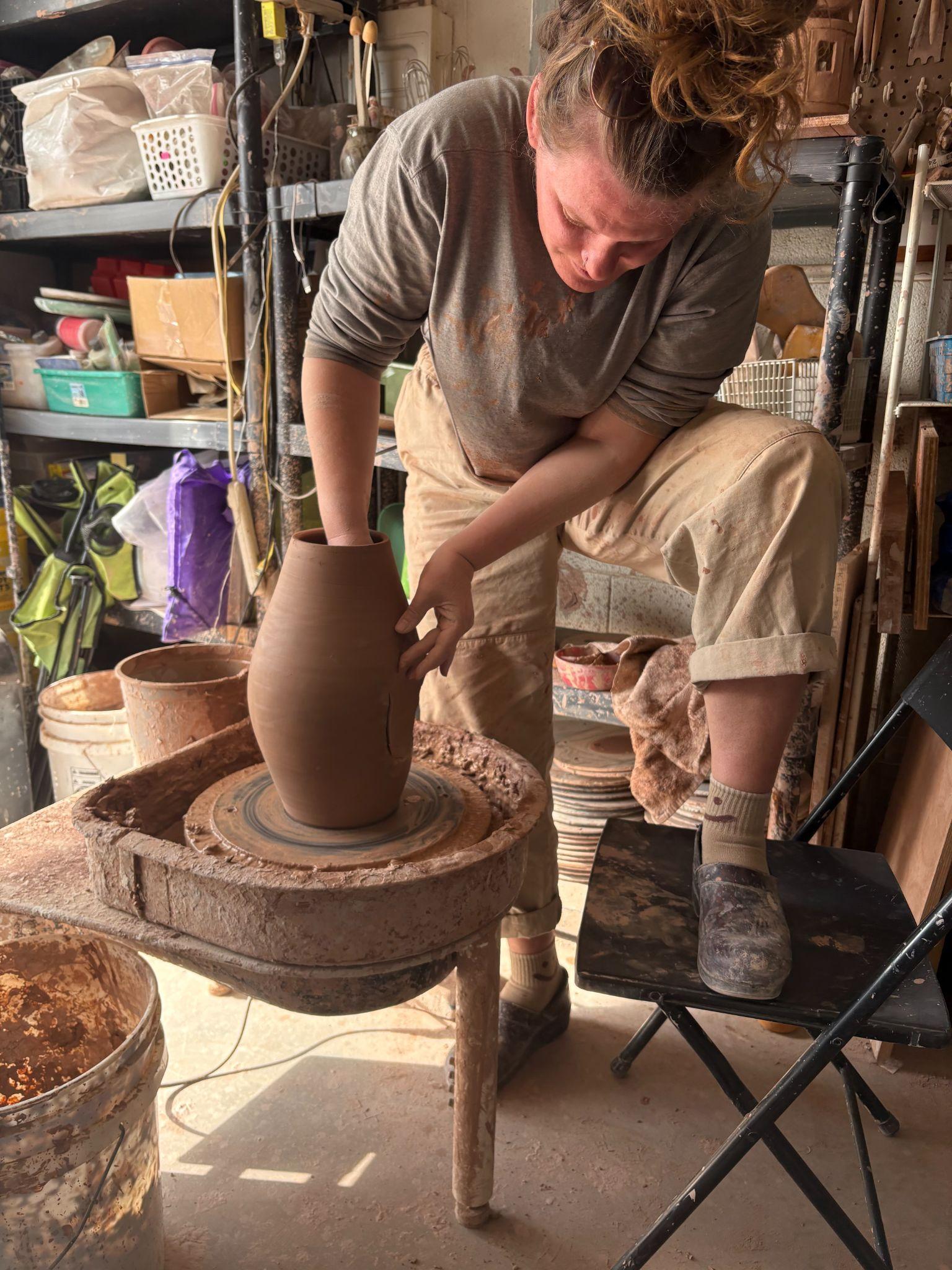
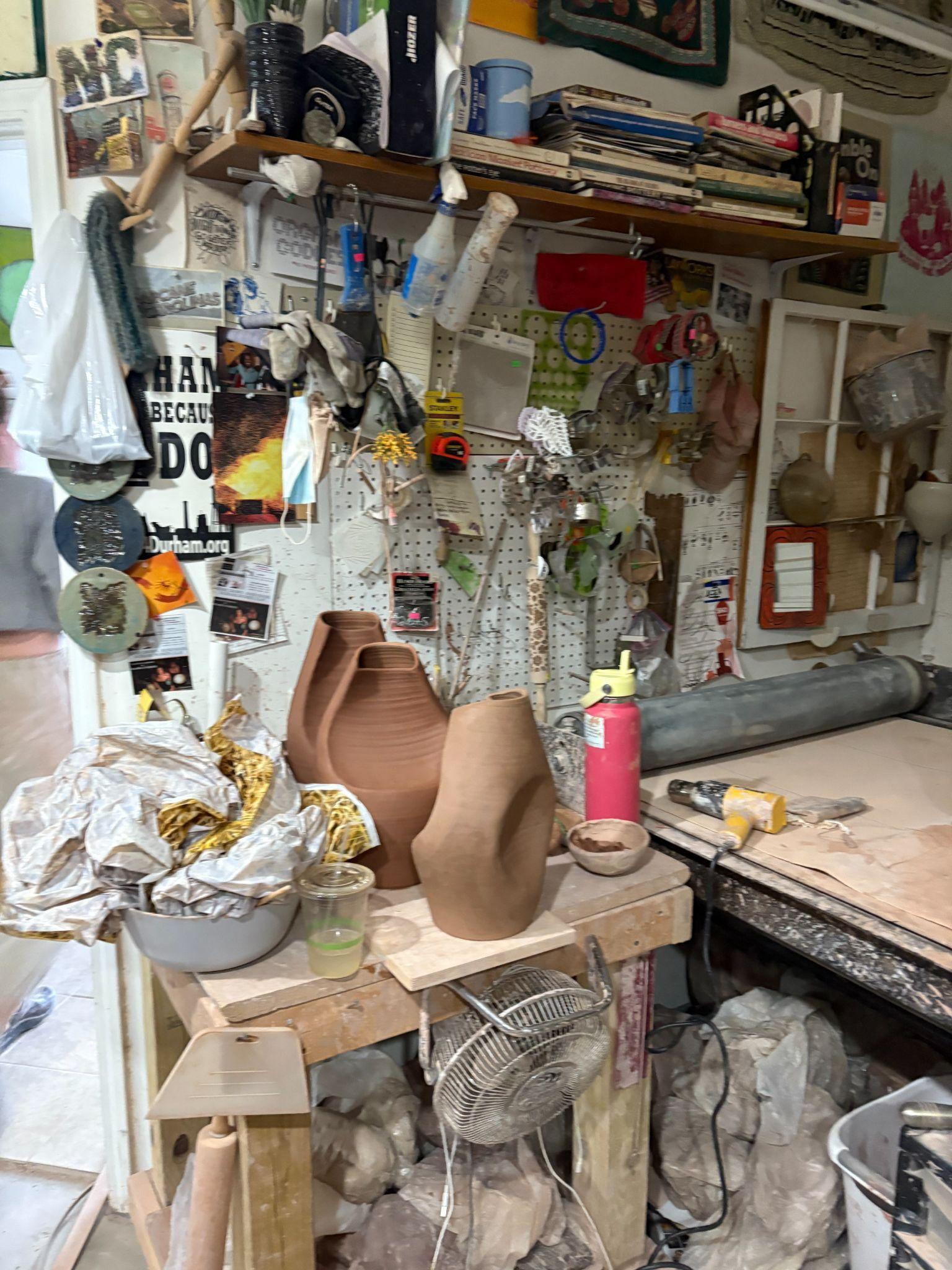
There are many different aspects of pottery beside just working at the wheel, however. To Julie, potters are part electricians, part wood preppers, and part construction folks.
“We kind of have to learn how to do everything,” she says. While working as a potter over the past eight years, she’s had to learn how to fix kilns, wire lamps to sell, and fix pugmills, which are clay mixing machines.
In addition to her work as a potter, Julie also works as a pottery teacher, holding classes at Liberty Arts three nights a week and at fellow potter Delores Farmer’s studio two nights a week. Once a month, Julie also teaches a class at the Duke Arts Annex, which often has a waitlist of over one hundred people.
Teaching is more than just instructional time, however. Also involved in that work are the pre-workshop and post-workshop duties—preparing the clay, cleaning the studio, organizing the pots, loading the kiln, firing the pieces, unloading the kiln, ensuring everyone gets their finished work. Despite the immense amount of work that goes into being a full-time potter, both on the wheel and off, Julie loves teaching.
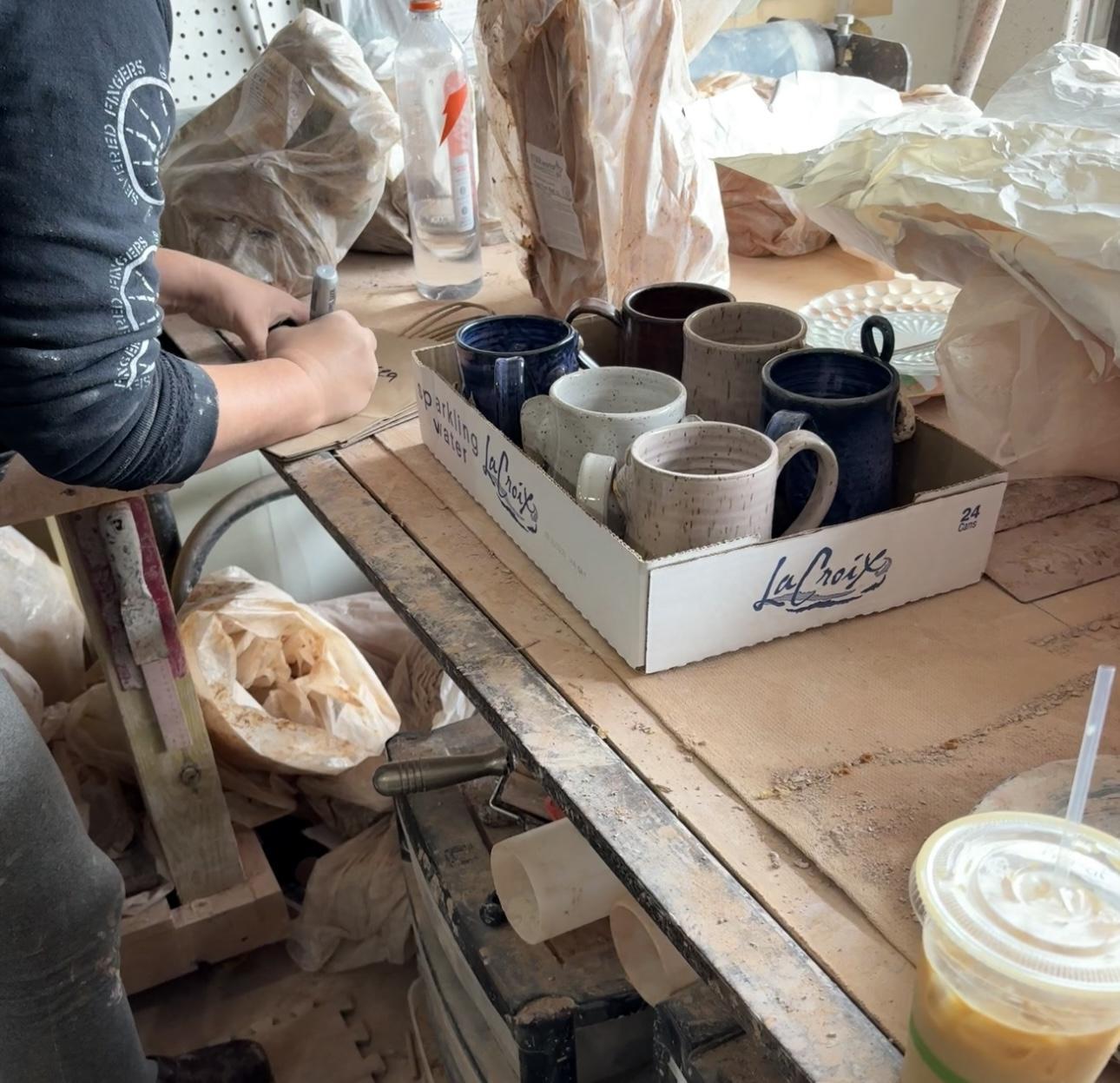
“I really, really love teaching pottery, because so often you get folks that have never worked on the wheel before,” she says. “And then you get them on the wheel, and, you know, they realize that they can make something. And it’s just, it’s so wonderful to watch people find their creativity.”
Teaching has also allowed Julie to meet a lot of people and has broadened her community in Durham, which she thinks is important as a person, but especially as a maker.
“And the community, the arts community in the Triangle and in North Carolina, is really the reason that I am still doing this full time,” she says. “I’m so committed to sticking with it because, you know, it’s just, it’s so amazing to meet other people and to share ideas.”
Building these strong ties is also a result of being present in the community—having a voice, being vocal, going to events. For a potter, community is also where you find the most opportunities. It’s how you hear about what kilns are getting fired, who has the connections you need, and where new clay spots are. Since its founding, Outer Loop Arts has been about making art and creating community in downtown Durham. Even after moving to New York, Julie knew she wanted to come back one day.
“I think Durham is a really special place,” she says. “I think especially for artists, it always has been. It’s always had a really great, established artist community here. And I think that’s pretty special, especially in the South.”
“I think making art, especially these days, is kind of a revolutionary act, you know?” Julie says. “And I think it’s important also that the art that you make reflects that.”
This profile is part of a special collaboration between the North Carolina Folklife Institute and Dr. Ben Bridges’ “Writing Material Culture” folklore course at UNC–Chapel Hill (Spring 2025). “Material culture” refers to the objects, tools, artistry, and everyday items that people make and use—and the stories those objects carry forward. Inspired by our shared commitment to community-centered storytelling, students spent the semester documenting the work, perspectives, and ongoing creativity of living North Carolina artists. Each student spent the semester learning to write about material culture through hands-on ethnographic research, culminating in these profiles published as part of NCFI’s Carolina Life & Lore series.